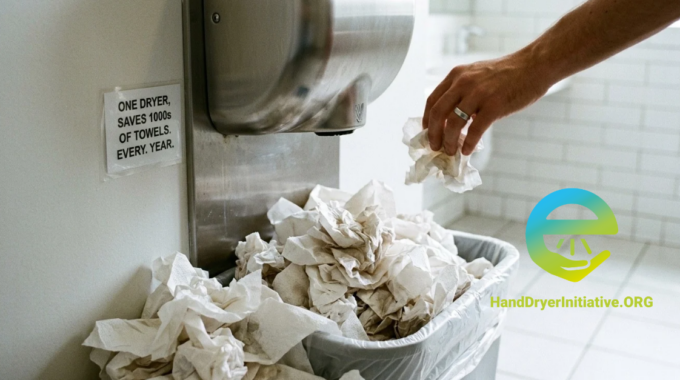
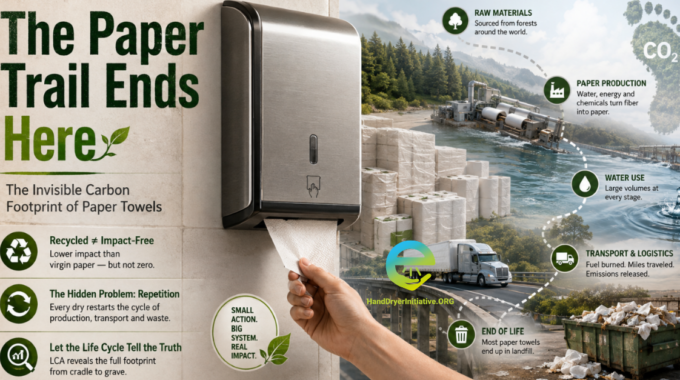
In Post 2 of our Handdryer Initiative series, we unpack the third-party TrueNorth Collective Life Cycle Assessment (LCA) (conducted under strict ISO 14040/14044 standards).
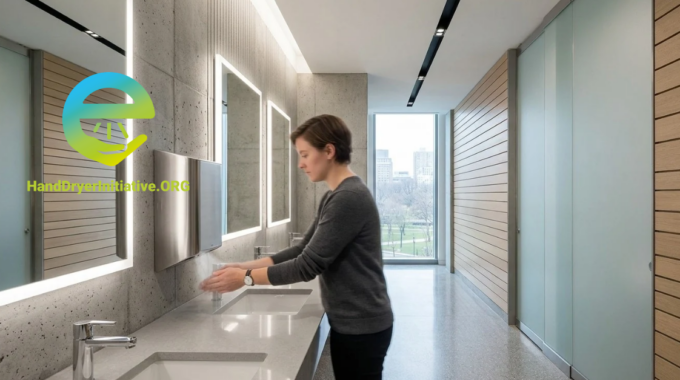
Winning LEED Credits and WELL Points in Modern Architecture
For architects, green building specifiers, and ESG directors, modern design is no longer just about aesthetics or structural integrity. It is an exercise in total carbon accounting and human wellness.
With net-zero targets rapidly approaching and tenants demanding verified sustainable spaces, every specification matters. Yet, when pursuing prestigious certifications like LEED v4/v4.1 or the WELL Building Standard, project teams often overlook one of the simplest high-impact areas in a commercial footprint: the restroom.
While HVAC overhauls and solar array installations carry massive capital expenditure, specifying high-efficiency hand dryers is a straightforward, low-cost strategy for securing crucial green building points. Here is how third-party verified hand drying hardware translates directly into LEED credits and WELL points for modern architectural projects.
The Documentation Engine: EPDs, HPDs, and Transparency
In modern building certification, generic claims carry zero weight. USGBC (LEED) and IWBI (WELL) require rigorous, third-party verified documentation to grant points. This is where product selection becomes critical. Excel Dryer pioneered third-party verified Environmental Product Declarations (EPDs) and Health Product Declarations (HPDs) for the hand dryer industry, giving specifiers the exact verified data needed to fulfill credit requirements.
How EPDs & HPDs Unlock Building Credits
-
LEED v4/v4.1 – Building Product Disclosure and Optimization (Materials and Resources):
-
Environmental Product Declarations (EPDs): Specifying products with ISO 14025 Type III third-party verified EPDs contributes directly toward the MR credit for Environmental Product Declarations. It proves the product’s life cycle impact has been independently audited from extraction to disposal.
-
Material Ingredients (HPDs): Health Product Declarations provide full chemical transparency, verifying that the hardware eliminates red-list chemicals and hazardous off-gassing, contributing to Material Ingredient Reporting credits.
-
-
WELL Building Standard v2:
-
Materials Concept (X07 – Materials Transparency): Requires transparent disclosure of product ingredients to safeguard indoor occupant health. HPD-backed hardware directly satisfies these documentation thresholds.
-
Waste Management Concept (N01 – Waste Reduction): Eliminating single-use paper streams supports waste diversion benchmarks required under WELL performance metrics.
-
Low-Hanging Fruit for Net-Zero 2050 Targets
As institutional investors and corporate tenants enforce strict ESG mandates to hit Net-Zero 2050 goals, facilities face a stark choice between continuous operational emissions and strategic electrification.
| Building Metric | Paper Towel Restroom Infrastructure | High-Speed Electrified Restroom Infrastructure |
| Operational Waste Stream | Ongoing Scope 3 waste generation (tons of non-recyclable paper sent to landfills annually). | Zero ongoing solid waste stream generated inside the facility. |
| Supply Chain Freight | Continuous Scope 3 transport emissions from ongoing deliveries and waste hauling. | Eliminated after initial equipment installation. |
| Grid Alignment | Locked into fossil-fuel-heavy manufacturing and transport that cannot be decarbonized by building systems. | Decarbonizes automatically as the local electrical grid transitions to renewable sources (solar, wind, hydro). |
| LEED/WELL Impact | Negative impact on waste performance metrics; zero contribution to disclosure credits. | Directly earns Materials, Energy, and Waste credit points. |
The Specifier’s Pivot: Electrification Made Simple
Building decarbonization is frequently associated with complex structural retrofits—replacing chillers, re-glazing facades, or installing battery storage.
However, transitioning commercial restrooms from paper consumables to high-efficiency hand drying represents one of the highest ROI decisions a specifier can make:
-
Immediate Scope 3 Reduction: Instantly removes a perpetual source of indirect supply-chain waste and landfill methane.
-
Simplified Compliance: Standardized EPD/HPD documentation streamlines the submittal process for LEED and WELL APs.
-
Future-Proof Infrastructure: Electrified drying aligns restrooms with all-electric building designs powered by clean energy grids.
Modern Specification Summary
By moving from disposable paper infrastructure to high-speed, verified hand drying, architectural specifiers turn standard commercial restrooms into assets for building certification and long-term sustainability goals.
Stay tuned for Post 4: We`re going to come back once more to an important issue “Why Counterfeit Dryers Defeat Your Eco-Goals”
This content was created with the assistance of artificial intelligence.
Related Posts