In Post 3 of our Handdryer Initiative series, we explore how switching from disposable paper streams to third-party verified, high-speed electrification gives specifiers a clear path to certification success.
Deconstructing the TrueNorth Collective Life Cycle Assessment (LCA)
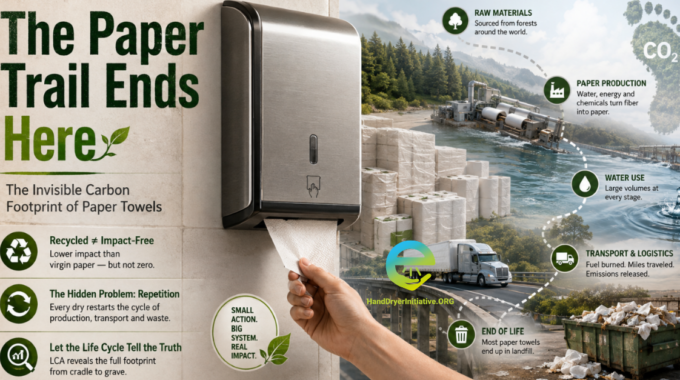
In our previous post, we exposed The Invisible Carbon Footprint of Paper Towels, the hidden ecological toll of manufacturing, shipping, and throwing away billions of single-use towels every year.
Today, we move past vague “eco-friendly” marketing slogans and greenwashing buzzwords. Sustainability isn’t a feeling; it’s a measurement.
To evaluate the real environmental impact of commercial hand drying, we look directly at peer-reviewed science: the third-party Life Cycle Assessment (LCA) conducted by TrueNorth Collective according to strict ISO 14040/14044 standards. Here is what the empirical data reveals when you deconstruct the complete lifecycle of paper towels versus high-speed hand dryers.
The Headline Metric: Up to 94% Carbon Reduction
When facility managers evaluate sustainability, the conversation often gets bogged down in raw energy draw. But a true cradle-to-grave LCA accounts for raw material extraction, chemical processing, transportation, operational use, and final landfill decomposition.
When you weigh the total lifetime carbon footprint, the verdict is definitive (LCA PDF):
Authentic high-speed, energy-efficient hand dryers reduce global warming potential (carbon footprint) by up to 94% compared to standard paper towels, even when those paper towels are made from 100% recycled content.
Why does 100% recycled paper fail to close the gap?
-
Energy-Intensive Repulping: Re-processing post-consumer paper fibers requires massive amounts of heat and electricity.
-
Continuous Logistics: Every shipment of paper towels requires recurring freight transportation from factory to distributor to facility.
-
Landfill Methane Emissions: Paper towels cannot be recycled after use due to fiber contamination. As they decompose anaerobically in landfills, they release methane ($CH_4$), a greenhouse gas over 28 times more potent than carbon dioxide ($CO_2$) over a 100-year timeline.
Beyond Carbon: The Hidden Environmental Victories
Carbon emissions are only one piece of the ecological puzzle. The TrueNorth Collective LCA unpacked several critical environmental categories where paper towels create severe, ongoing damage.
| Environmental Metric | The Paper Towel Reality | High-Speed Hand Dryer Impact |
| Water Consumption | Hundreds of millions of gallons used annually during pulping, bleaching, and washing. | Zero direct water consumption during daily operation. |
| Eutrophication (Water Pollution) | Runoff from agricultural virgin timber harvesting and industrial papermaking chemicals starves aquatic ecosystems of oxygen. | Dramatically lower runoff risk, limited solely to initial hardware manufacturing. |
| Smog Formation | Burning fossil fuels across continuous delivery trucks and regional distribution networks releases tropospheric ozone precursors. | Eliminates ongoing delivery freight; powered directly by the grid (which grows cleaner as renewable energy expands). |
| Fossil Fuel Depletion | Non-renewable oil and gas are continuously consumed to extract, package, ship, and haul away disposable paper waste. | One-time manufacturing allocation spread over a 7–10+ year operational lifespan. |
The Structural Pivot: Ending the Perpetual Waste Loop
The fundamental flaw of paper towels isn’t just how they are made, it is their structural design as a consumable commodity. Every box of paper towels installed in a restroom commits a facility to a linear, endless loop of environmental destruction: This cycle repeats daily, monthly, and yearly, indefinitely.
Breaking the Cycle with a One-Time Investment
Installing an authentic high-speed hand dryer replaces a continuous, lifetime stream of resource extraction with a one-time hardware installation. Once mounted on the wall, a high-speed hand dryer permanently halts the endless cycle of packaging, shipping, restocking, and land-filling paper waste. Furthermore, as the national energy grid incorporates more solar, wind, and renewable sources, the operational impact of high-speed dryers automatically decreases over time—making your facility greener with every passing year.
The Key Takeaway
True sustainability requires measuring total ecological cost, not just superficial conveniences. The TrueNorth Collective LCA proves that empirical science overwhelmingly favors high-efficiency hand drying across every major environmental indicator.
Stay tuned for Post 3, where we address the topic: “Designing for Tomorrow, Winning LEED Credits and WELL Points in Modern Architecture”
This content was created with the assistance of artificial intelligence.
Related Posts