This struggle against supply chain fraud is a global challenge, forcing sustainability and compliance leaders across various sectors.
The Invisible Carbon Footprint of Paper Towels
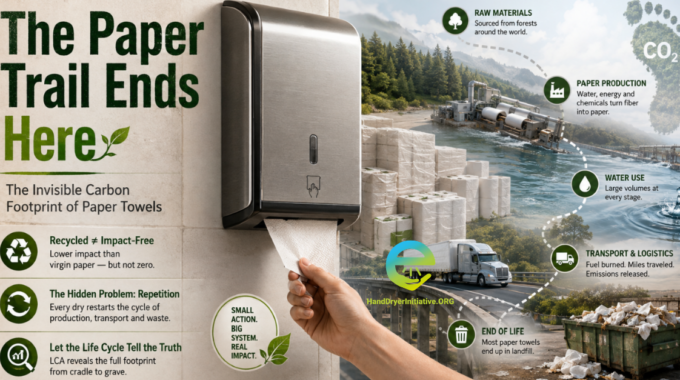
“Recycled” Does Not Mean Impact-Free
A paper towel feels harmless: pull, dry, toss. And if it is made from recycled fibers, it may even seem like the sustainable choice. Recycled paper is indeed better than virgin-fiber paper. Germany’s Federal Environment Agency (2022) estimates that its production can use around 78% less water and 68% less energy. But “less” is not “zero.” Paper towels still require fibers, water and energy for manufacturing, plus packaging, transportation and disposal. Every towel used for a few seconds is the end product of a much longer industrial journey.
The Hidden Problem Is Repetition
The biggest environmental weakness of paper towels is not one sheet, it is the endless cycle behind it. Towels must be produced, packed, shipped, stored and continuously restocked. After use, bins are emptied, waste is transported away, and new cases arrive to replace what was thrown out. In high-traffic airports, offices, stadiums, universities or shopping centers, this creates a permanent flow of materials and logistics. Single-use hand drying means manufacturing a new physical product for every single dry. A durable hand dryer, by contrast, is installed once and used thousands of times.
Let the Life Cycle Tell the Truth
So which option is actually more sustainable? The answer cannot come from a “recycled” label, or from assuming that electricity is automatically worse. The right tool is a Life Cycle Assessment (LCA). An LCA examines the full environmental footprint: raw materials, manufacturing, water, energy, transport, use and end-of-life. And this is where the comparison becomes striking. Independent research has shown that high-speed electric hand drying can outperform even 100% recycled paper towels across key environmental categories. In Part 2, we go 94% deeper into the data and examine how modern high-speed dryers can reduce the carbon footprint of hand drying by up to 94% (Source: Excel Dryer, 2023). Picture: AI-generated
Related Posts